Showing posts with label Reading. Show all posts

Tuesday, 11 August 2020

Think Thick!

Hello!

You may find this post really helpful if you take Reading/Reading Comprehension in your classes. Well, it is actually applicable to all teachers and across subjects but through reading we can make the most out of it.

Asking questions not just makes our class interactive but also helps our children think. Reasoning skills play an important role in our teaching world, not just for students but also for us teachers.  

Let's see how we can help children think and reason better. One of the ways is by asking them to answer and make THIN and THICK QUESTIONS.

Beginning with the THIN QUESTIONS..

Examples of thin questions:
  • How many?
  • Who?
  • What?
  • Where?
  • When?
Answers to THIN QUESTIONS can be found right in the text. They are:
  • Easier to answer
  • Yes or No Questions
  • Usually only one answer
While reading story books or any text encourage children to find answers to such questions and also make THIN questions. Play a game within your group where kids make their own questions and everybody takes turns to answer. 

Examples of thick questions:
  • Why?
  • How come?
  • What if..?
  • How did?
  • What does the author mean?
  • What would happen?
  • What might..?
  • I wonder...?
Answers to THICK QUESTIONS cannot be found right in the text. Kids need to put on their THINKING CAPS!!
    Thinking cap
  • Many answers to same question
  • Need to use evidence from the text
  • Use background knowledge
  • Difficult to find directly in the text


Play the same game as mentioned above for helping kids to answer and make THICK questions. 


Thick vs thin questions


By doing an activity on 'Thick and Thin Questions', kids not just learn how to find clues for the answers but they also learn to make questions. Thinking and reasoning skills are further deepened.

I hope you find this activity useful. Keep reading for further ideas!! :)

Happy to receive comments!! 

Friday, 10 April 2020

Connecting Texts

Hello!

Kids comprehend better when they make connections with the books/texts they read.
By comprehension I mean, 'making meaning' of texts. A purpose for engaging with the text becomes necessary to be able to enjoy it.

Building connections is a strategy that can help kids comprehend and relate with the text better. 
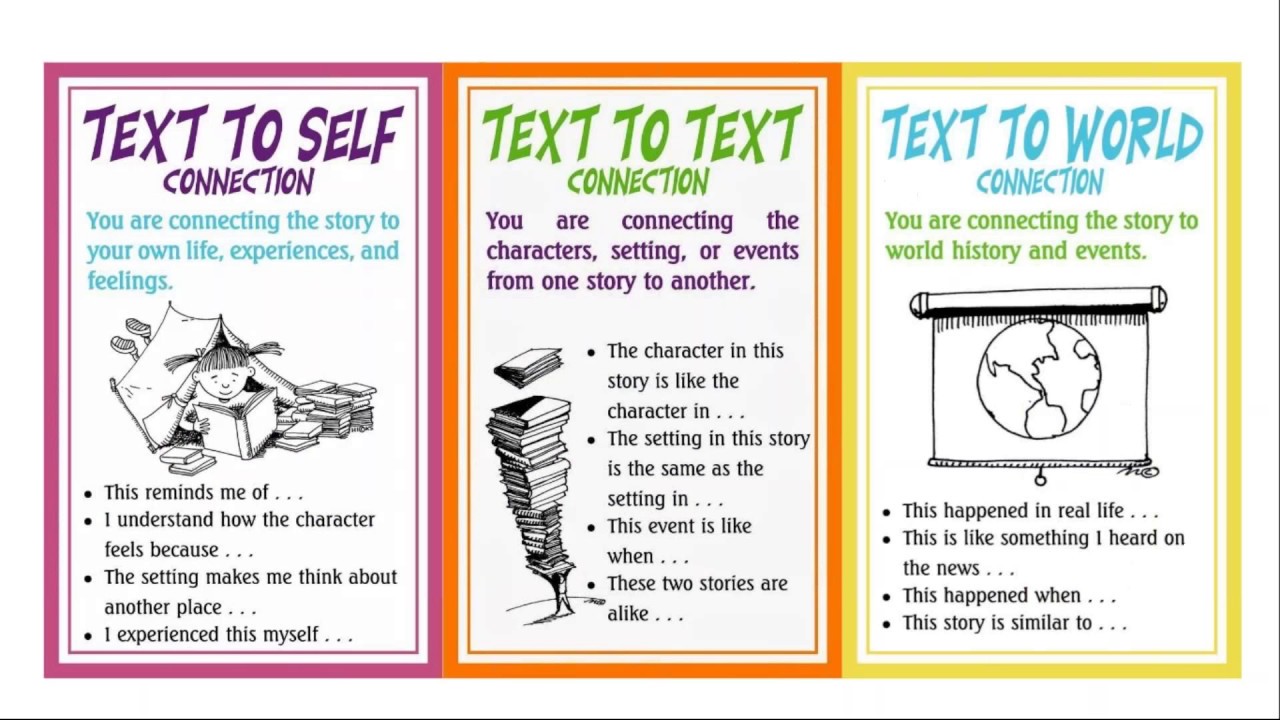
There are mainly three types of connections that a child can make:
  • Text-to-Self - connecting the text to yourself and your experiences
  • Text-to Text - connecting the text with another book that you might have read
  • Text-to-World - connecting the text with events in real-world

cuyhelji / Text to self connectionText-to-self connections are personal connections that a reader makes between a piece of reading material and the reader’s own experiences or life. 

Example:  "This story reminds me of the time when I visited my grandmother's house and we cooked biryani together."


Making Connections Anchor Charts with Question Stems by Mary ...
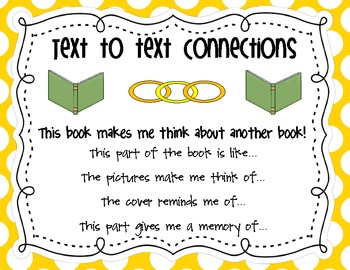
Sometimes while reading, students make connections with other similar texts/stories/books that they have read. These are text-to-text connections. 

Example: "The cover of this book reminds me of  the book, 'Granny Torelli Makes Soup', which I read last year in grade 04."


Text to World Connection- Animal Report ExtensionText-to-world connections are larger connections that goes far beyond our personal experiences. 
Students here make connections with the events happening in the world which they may have come across through television, newspapers, movies, etc.

Example: "I was watching a program on T.V. last night, it talked about similar events as in this article."

To effectively used this strategy, demonstrate or model for students how to make connections. 

The simplest is text-to-self, so we can start with that. You could read a book to your kids and use phrases like, 'this reminds me of a time.....' or 'this reminds me of...' to make connections between the book and your life. In a similar way ask the kids to build such connections and share with all.
Once they are familiar with making connections with self, move on with the other two types.  

I am sharing a few connecting statements that you could use as prompts for class discussions.

This part reminds me of....

I felt like...(character) when I....

If that happened to me I would....

This book reminds me of...(another text) because....

I can relate to...(part of text) because one time....

Something similar happened to me when....


You could also use the following questions to help kids connect.

                                                     Text-to-self:
What does this remind me of?
How is this different from what happened with me?
Has something like this ever happened to me?
How did I feel?

                                                     Text-to-text:

Which other books of the same author have I read?
How is this text similar to other texts I’ve read?
How is this different from other books I’ve read?
Have I read about something like this before?

                                                     Text-to-world:

What does this remind me of in the real world?
How is this text similar to things that happen in the real world?
How is this different from things that happen in the real world?
How did that part relate to the world around me? 
Making Connections - 2017 Summer Program - YouTube

Keep Reading, Keep Connecting!!

Monday, 6 April 2020

Mysterious Mummies!!


Hello!
I have always been curious about the Egyptians and the mummification of bodies. The more I come across the history of Egypt the more I am intrigued. 

In one of the reading classes, my co-teacher and I had started reading about Cleopatra to our students. The discussions thereafter were never-ending and they wanted to know more about the ancient Egyptians, their writings, their food, mummies and pyramids.


While surfing the net, I came across 
https://www.childrensuniversity.manchester.ac.uk/ . It was just what I needed! 

The content was simple and apt. The activities were engaging and guess what, kids could also make their own 'mummy'! 

The home page of the website looks like this: 
Choose Ancient Egypt and start exploring. You will come across many sub topics.
Depending on the age group and your class strength, you could cover all the sub topics in  one class or spread them across 2-3 classes.
Some of the activities have audio as well hence, you might need headphones.

As a teacher, what I like best about the website is there is no need to sign up. Although, the topics are limited; I find them very effective and gripping. The slides are informative,  illustrative and colourful.

P.S. Would you like to write like an Egyptian? 
       Just click on the link below and type your name. :-)  

   
       https://www.penn.museum/cgi/hieroglyphsreal.php


                   R       
                   U
                    C
                    H
                    I
                   K
                   A