Showing posts with label Language Arts. Show all posts

Tuesday, 12 January 2021

Dear Diary...

Hello!

Diary writing is an excellent practice that can help students polish their writing skills. It not just aids in building complete and meaningful sentences but students learn to express through words at a very early stage. It also gives the freedom to choose what you want to write about.

My students of grade 02 came across this form of writing when we were reading about a character in a story who loved to write in her diary. The idea was new to my class but we started simple i.e. by brainstorming ideas on writing a diary. 

We looked at a few samples of diary writing and made a note of following points:

  • writing the date
  • addressing it to the diary
  • feeling free to write about anything we would like to
  • keeping the diary a secret if we want to
  • it can be written whenever we want to write
  • we can also illustrate to express
In the beginning it was a little challenging for 7-8 year olds to decide on a topic. So, we decided to write about what they did last Sunday. This got them thinking and it was easier to narrow down ideas and thoughts. 

For any creative piece, I always like to begin with the whole class and then move on to them writing individually. We chose to write about our field trip to the museum since it was common to us all. In this process, I write on the board while students help me with sentences and ideas. They are guided and corrected as well. Once the class diary was ready, we read it out together. 

After this, we move on to writing in smaller groups with our group teachers. Here the students reach out to teachers when stuck and it can be better monitored if they are on the right track. Once they are done, if they choose to, they can read out their piece to their teachers and friends. 

This activity worked well for my class and helped my children in developing better writing skills. Some of them had even started writing in a diary at their homes. It is great exercise that you should also try with your class.


Thursday, 17 September 2020

Thank you, John Venn!!

Hello!

Understanding the differences and similarities between physical and political maps can be slightly challenging for seven and half year olds. 

To simplify it, I decided to use a Venn diagram in my Social Studies class.

Before doing this activity, students should be familiarized with what are physical and political maps. 

Start with the differences since they are easier to identify. Have both the maps displayed and ask your class to brainstorm some of the differences between them. Write down on the board as they discuss. 

Next, move on to talking about the similarities. Have them written in the center on the board. 

Something like this:

Once the discussion is over, draw circles in a way that the similarities are in the overlapping part of the two circles and the differences  on the either sides.

Encourage your class to draw their own Venn diagrams and they could even illustrate, if they wish to. 

For example:

Google search image

Some other subjects/topics where Venn diagrams have helped me make learning fun are:

  • Social Studies - Understanding the similarities and differences between maps and globes, latitudes and longitudes, comparing festivals, religions and so on. 
  • Language Arts - a comic strip and a short story, poems and stories, singular and plural (the nouns which do not change can be in the centre; like - deer, moose, sheep)
  • Science - plants and animals, stars and planets 

Although a Math concept, but Venn diagrams have proved to be very useful across subjects and concepts. I often try to integrate them in my class. I hope you like the idea and try them out.

Please feel free to suggest more concepts where I could apply Venn diagrams in my classroom.


Monday, 25 May 2020

Partner Hunt!

Hello!

This is a great icebreaker for introducing many grammar topics like masculine-feminine, singular-plural, synonyms-antonyms and so on. 

It's called Partner Hunt! It's fun and a lot of learning happens at the same time. I used this game for introducing Nouns - gender. 

The instructions are simple - look for your partner, find a spot and sit with your partner. 

If you want this activity to be less noisy then you could challenge your kids to look for their partners by walking towards each other and whispering the nouns mentioned in their slips of paper.

We were 5 teachers so it was easier to organise and conduct the game. If you are the only teacher in class then you may have to prepare a little in advance. Although, I feel, if teachers become a part of this activity then, a lot of variation is possible and you also get a lot of help from them.

Planning:
  • Have slips of papers with feminine and masculine nouns like: uncle - aunt, lion - lioness, father - mother, etc, each written on an individual slip of paper.
  • Make sure each set is complete otherwise a child may end up with no partner at the end of the game.  
  • Fold them and keep them ready. 


      How to play:
  • Have the nouns in a bowl
  • Pass the bowl around and ask the students to pick up only one slip of paper each
  • Once everybody has a slip ask them to walk around the class and look for their partners
  • As soon as they find their partners they must find a place and sit together 


Once everybody has a partner ask them to call out the nouns from their slips. As they call out make a list on the board having the set of nouns (masculine-feminine) written together. You could also have them write down a few of the nouns in their notebooks towards the end of the class. 

I personally like this activity as kids have a lot of fun while hunting for their partners and it requires very simple preparation.

Enjoy!

P.S. If you are playing the game say with Std. 03 kids then have nouns which they are familiar with from previous classes. This will keep them engaged and they will enjoy the activity even more. Later, you could build up from there and introduce newer nouns as per the class level. 

Thursday, 2 April 2020

Writing a POEM

Hello!

I came across this particular style of poetry writing through one of the lessons in my 2nd grade. It's fun to read and simple to compose.

For this, kids should have some previous knowledge about common nouns and verbs. It's a good idea to revisit them with your class before beginning the lesson. 

Once they are familiarised with the concepts, show them a sample of the poem that they are expected to write and discuss the pattern in it.

 Sample:   
                        
Busy Birds                                                                          
                                                                                         The pattern is:
Birds chirping,                                                     Noun verb,
Birds singing,                                                       Noun verb,
Birds flying, flying, flying.                         Noun verb,verb, verb.
                                                                                               
Birds eating,
Birds drinking,
Birds fluttering, fluttering, fluttering.

Birds brooding,
Birds resting,
Oh look! The sun has set!
Birds sleeping, sleeping sleeping.

Now, to begin with, ask your class to choose a noun and tell them that they will be composing a class poem using the noun they suggest (I always like doing a class poem before individual ones). 
Write the noun in the center of the board and draw a cloud around it. Then, ask them to brainstorm and suggest the verbs that can be used with the noun chosen.

Example:

They should come up with at least 9 verbs if they are required to write a 3-stanza poem.

Once we have the verbs ready, we can start writing our poem. Ask them to place the action words in way that builds a connect between the lines.


For example - playing and hiding can go together in one stanza whereas studying, talking and asking in the other. 

Their class poem may look like this:

Children hiding,
Children running,
Children playing, playing, playing.

Children talking,
Children asking,
Children studying, studying, studying.

Children yawning,
Children sleeping,
Here comes the Tooth Fairy!
Children dreaming, dreaming, dreaming.


Ask them to give a title to their poem and finally, have them read it together. 

Suggest a title for the class poem in the comments section if you like the post... :-)

Tuesday, 31 March 2020

Cooking? Child's Play!


Hello!

Cooking can be a child's play as well as their learning! Let's see how...

I am going to talk about using Time Words for writing instruction texts like - recipes, making a craft, giving directions, etc.
They help students write the events/instructions in a sequential manner. To explain further, I will take up a very simple example of making a lemonade. 

The recipe is super simple and Parents could also try it with their kids during their summer break for a refreshing twist!

Before starting the lemonade-making activity, discuss the time words - first, next, then, after that, later, finally and their usage in sentences and texts. 

The following is just an idea which you could use to do that:

Ask a child to use time words to tell you the steps for brushing teeth or what the child did after waking up in the morning. Encourage them to use time words while narrating the order of events.

Making Lemonade
Let's begin!

You will need:
Hotel & Restaurant Products - Stainless Steel Water Pitcher Manufacturer  from Delhisugar in a wooden bowl - Calorie Control Council
Lemons: Health Benefits, Nutrition, and Side Effects
  • a sliced lemon
  • a glass of water
  • some black salt
  • two teaspoons of sugar
  • an empty jar

Keep the ingredients ready on a table and gather your class around. Ask them if they have made lemonade before. If so, then incorporate their recipe or else show them how its made. While making the lemonade, say the steps aloud using the time words.

For example:

First, pour a glass of water in an empty jar.
Next, add two teaspoons of sugar and a pinch of black salt to the water.
Then, squeeze a lemon into the mixture.
After that, give it a nice stir.
Finally, pour the lemonade in the glass and enjoy your drink!

Remember: Children should ask an adult to slice the lemon into two, using a knife.

Once the activity is over, you can ask the students to go back to their places and write the instructions in their notebooks. To make it more engaging, you could ask them to follow the instructions they have written and make a glass of lemonade for themselves.

Overall, making of the lemonade turned out to be an interesting lesson for my class. We even enjoyed having the lemonade made by us. :)

Keep Cooking! Keep Learning!

Wednesday, 25 March 2020

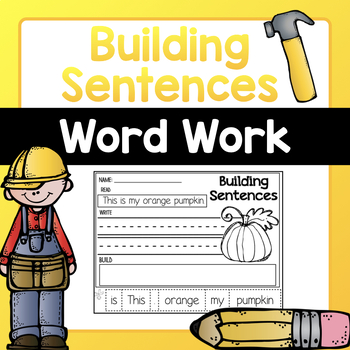
Building Sentences

Building Sentences Packet by Jessica Rosace | Teachers Pay Teachers


Hello!

Writing is a skill which a child can acquire well when it's developed at early stages. 

As part of my class schedule I would dedicate 10-15 minutes on encouraging the students to write simple yet meaningful sentences. The age group of students that I am referring to is between 7-8 years. However, I think, the same strategy can be applied across all elementary levels. 


To begin with, we can talk about the 5W questions (who, what, when, where and why). This will ensure that the sentences are meaningful and detailed. Have the 5Ws written on the board one below the other. Their arrangement can be flexible; however, I prefer starting with who or when. Always start by constructing a class sentence before each one does their own. Students can take turns to add words to 5W questions making sure that they are well connected. 

The following example shall be helpful:

who - Ramesh
what - was studying
when - last night
where - in his room
why - because he had to prepare for his exam.

After the mind map, ask the students to write it like a sentence. Make sure they capitalise and punctuate.

Ramesh was studying last night in his room because he had to prepare for his exam.

Students can also begin with the when question. Then the sentence would look like this:

Last night, Ramesh was studying in his room because he had to prepare for his exam. 

Grammar concepts can also be reinforced with the activity. For example - 'who' can be a proper noun or a common noun, 'what' is the verb, 'when' can be referred to as time words and 'where' is the preposition. 

Once the kids are comfortable with building a mind map they can be encouraged to write sentences directly.

For older kids, the same activity can be done by making it more challenging and asking the students to add adjectives before nouns in the sentence and also adding a 'how' question if possible.

I hope the activity is useful and it helps students write meaningful sentences and well-thought passages.